

WEST Center celebrates 10-year anniversary
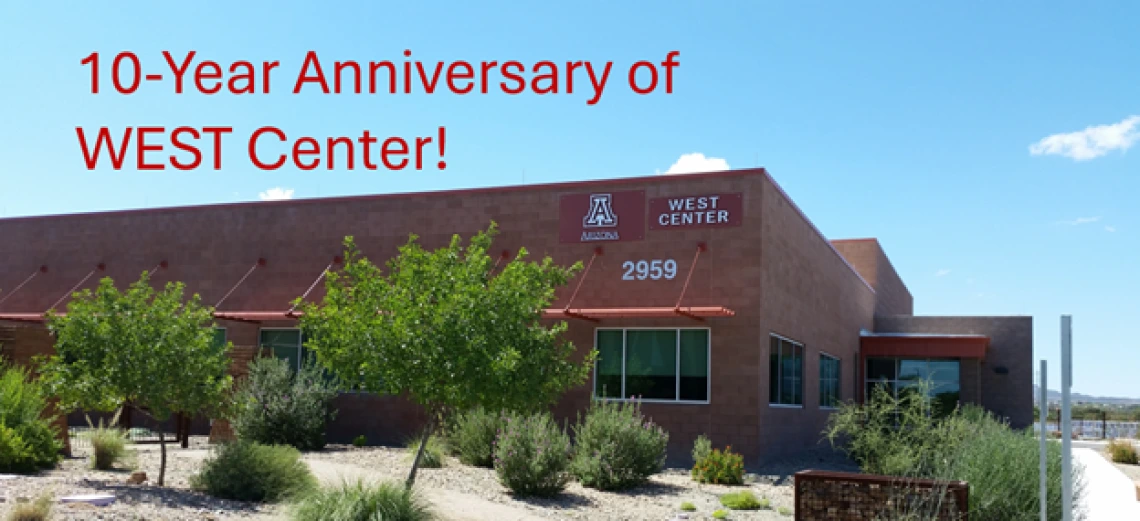
On December 10, 2025, WEST faculty, staff, and students gathered to celebrate both the holiday season and 10 years of successful research and learning at the WEST Center. During the celebration, Regents Professor and WEST Director, Dr. Pepper, recounted the Center’s history, stating that the facility originated in a longstanding 25-year relationship between the University of Arizona and Pima County Regional Wastewater Reclamation Department (RWRD).

Dr. Pepper and Dr. Achilli cut a celebratory cake at WEST's 10-year anniversary gathering.
Due to the University and County’s track record of productive research collaboration, Dr. Pepper received a phone call from the then-Director of Pima County RWRD, Mike Gritzuk, in 2011. Mr. Gritzuk told Dr. Pepper that the County planned to build a Water Campus and wanted a University of Arizona presence. Dr. Pepper and Dr. Gerba, along with an Engineering faculty member, were asked to design a building that would allow for innovative research related to water, wastewater, and energy. The team set about designing a space that included offices and a variety of laboratories to support the work of interdisciplinary experts (e.g., microbiologists and engineers), at multiple scales (e.g., bench, intermediate, and field scale testing). Plans were approved by Pima County and construction began with funding provided by the County. In early 2016, University of Arizona researchers, staff, and students moved into the WEST Center!
During its first 10 years, WEST has been incredibly successful. There are currently 20 faculty/staff and almost 40 students, learning new skills, supporting education, and contributing to research endeavors at the Center. During the past years, over 200 additional students, staff, faculty, and visitors have engaged in projects at WEST, benefiting from collaborations with interdisciplinary experts and access to state-of-the-art technologies and approaches.
At the anniversary celebration, Dr. Pepper (WEST Director), Dr. Achilli (WEST Deputy Director and Associate Professor), and Dr. Betancourt (Associate Research Professor) highlighted several of WEST’s impactful projects:
- Image

Dr. Pepper and two researchers, Erika Stark and Nick Betts-Childress, process wastewater samples at WEST Center in 2020.
Wastewater-Based Epidemiology (WBE): In 2020, when the COVID-19 pandemic began, WEST began a WBE program to support public health across the country and at the University of Arizona. WBE essentially involves monitoring infectious agents in wastewater as an indicator of disease in a community. During the COVID-19 pandemic, WEST received and analyzed wastewater samples for SARS-CoV-2 from numerous utilities across the United States. The Center’s team was then tasked with monitoring dormitories at the University of Arizona campus in order to rapidly identify COVID-19 infection, avert outbreaks, and allow the University to remain open during unprecedented times.
- Per- and Polyfluoroalkyl Substances (PFAS): PFAS is ubiquitous in the environment. It ends up in wastewater and, during treatment, partitions to the solid phase (i.e. biosolids). When biosolids are land applied, the concern has been “will the PFAS leach from the biosolids, through the soil, to the groundwater, which people then drink?” Further, “is there additional risk of indirect exposure to PFAS through crop uptake of the chemicals and subsequent consumption of foodstuffs grown on land application plots?” In 2020, WEST conducted a study of PFAS in soils in Pima County. Results showed low incidence and mobility of PFAS at local land application plots. These findings influenced Pima County biosolids disposal policy. WEST is now conducting a national study of PFAS, analyzing soil and plant samples from 21 land application sites in 16 states. Results of the nationwide effort will provide insight and guidance to wastewater utilities, farmers, and policy makers across the country.
- Department of Defense Water Reuse System: In a three-year project (2020-2023) led by WEST’s Dr. Achilli, researchers worked on water reuse solutions for the Department of Defense (DOD). With collaborators at the University of Southern California and University of Nevada, Reno, a novel ultrafiltration membrane bioreactor – membrane distillation (MBR-MD) system was developed and piloted. This successful project provided the foundation for the development and funding of the ongoing Water Reuse Consortium.
- Image

The reverse osmosis system and other technologies support water reuse research at WEST Center.
Water Resiliency Program and Water Reuse Consortium: The University of Arizona’s Water Resiliency Program, based at WEST Center, is part of a Water Reuse Consortium between the U.S. Army Engineer Research and Development Center (ERDC), the University of Arizona, the University of Southern California, and the University of Nevada, Reno. This Consortium leverages the combined knowledge, resources, and engineering expertise of these three academic institutions and seeks to revolutionize water reuse practices and promote sustainable solutions for communities, industry, and the environment. Water Resiliency projects are comprehensive, engaging experts in engineering, microbiology, public health, data science, and more.
- Private Industry Partnerships: The expertise and facilities available at WEST Center have encouraged multiple private industry research partnerships. Examples of current industry partners are Yokogawa and Vodaa Technologies.
- Water quality and safety: Experts at WEST Center are engaged in developing techniques to monitor viruses in aquifer systems and recycled water. These efforts are particularly important in arid regions, and are essential to ensuring water quality as water reuse applications expand.

The WEST Center provides unique access to technologies and equipment and a variety of water qualities due to its close partnership with Pima County and co-location with the County's Agua Nueva Water Reclamation Facility (WRF). It has attracted leading researchers in the water and wastewater fields, and facilitated national and international collaborations. Students at WEST are involved in important efforts to address problems of significance to human and environmental health.
Congratulations to WEST on its first 10 years of making vital contributions to a more secure and sustainable future!