

WEST researchers study natural alternatives for disinfection and sanitation

In a series of studies, a WEST Center team – in collaboration with the University of Sonora and with funding from an industry partner – is exploring the efficacy, and optimization, of organic acids and plant-derived compounds to reduce viral and fungal populations in various environments. Of special interest are indoor environments where many people spend up to 90% of their time, and which contain diverse populations of viruses, bacteria, fungi, and protozoa with the potential to cause illness (Kalaiselvan et al., 2022). While most current commercially available disinfectants and sanitizers contain active ingredients such as alcohols, acids, sodium hypochlorite, surfactants, quaternary ammonia compounds, oxidizing agents, halogenated compounds, or hydrogen peroxide (Gerba et al., 2024; Lin et al., 2020), these products often convey negative environmental and/or health impacts.
Utilizing natural compounds as alternative disinfectants has great potential to reduce unintentional harm caused by more hazardous chemicals that may bioaccumulate or have a negative impact on humans or the environment. Essential oils from plants (e.g., clove, thyme, cinnamon, oregano, eucalyptus, tea tree), extracts (e.g., grape seed, green tea), and natural acids have all been found to have intrinsic antimicrobial properties. Seeking to build on the body of research that exists on the topic, the research team at WEST Center began their investigations with an extensive literature review of both antifungal and antiviral studies that have evaluated natural products. Two review publications, “Antiviral Natural Products, Their Mechanisms of Action and Potential Applications as Sanitizers and Disinfectants” (Boone et. al., 2023) and “Antifungal activity and mechanism of action of natural product derivates as potential environmental disinfectants,” (Silva-Beltran et. al., 2023) were produced to synthesize and document previous research.
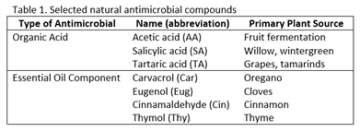
Following these review articles, WEST researchers conducted a new study to evaluate the efficacy of several organic acids and plant essential oils against three bacteriophages and two mammalian viruses. The three bacteriophages were selected to include different genomic characteristics (RNA vs DNA, single-stranded vs double-stranded), while one mammalian virus was enveloped and the other non-enveloped. Several organic acids and components of essential oils were selected (see Table 1) and their disinfection capacity tested. The publication, “Virucidal Efficacy of Organic Acids and Plant Essential Oils” (Silva-Beltran et. al., 2025) describes the study and results.
Key Highlights from the published work include:
- Salicylic Acid Was a Star: This common plant hormone achieved more than a 4.4 log₁₀ reduction in virus levels within just one minute, outperforming other tested compounds.
- Essential Oils Show Strong Results: Carvacrol and thymol, found in herbs like oregano and thyme, delivered up to 5.0 log₁₀ reductions against certain viruses. Eugenol, a clove-derived compound, also proved highly effective.
- Broad-Spectrum Activity: These natural products worked against both non-enveloped and enveloped viruses, including human coronavirus and feline calicivirus, with reductions exceeding 3.2 log₁₀ in 10 minutes.
- Eco-Friendly Potential: All tested compounds are generally recognized as safe (GRAS), making them viable for use in homes and workplaces as sustainable disinfectants.
- Resistance Patterns: While most viruses were susceptible to natural products, the ssDNA bacteriophage ΦX174 showed notable resistance, highlighting the need for tailored approaches.
Researchers from this Environmental Science team at WEST Center will continue to investigate the potential for plant-based sanitizers to reduce infection risks and reduce reliance on harsh chemicals. Up next are studies to better understand the complementary nature of plant-derived acids and oils to boost their efficacy against harmful pathogens.
References:
Boone, S. A., Ijaz, M. K., Bright, K. R., Silva-Beltran, N. P., Nims, R. W., McKinney, J., Gerba, C. P. (2023). Antiviral Natural Products, Their Mechanisms of Action and Potential Applications as Sanitizers and Disinfectants. Food and Environmental Virology 15: 265-280. doi.org/10.1007/s12560-023-09568-x.
Gerba, C. P., Boone, S., Nims, R. W., Maillard, J.-Y., Sattar, S. A., Rubino, J. R., McKinney, J., & Ijaz, M. K. (2024). Mechanisms of action of microbicides commonly used in infection prevention control. Microbiology and Molecular Biology Reviews, 0, Article e00205–22. doi. org/ 10. 1128/ mmbr. 00205- 22.
Kalaiselvan, P., Yasir, M., Kuppusamy, R., Willcox, M., & Vijay, A. K. (2022). Ability of essential oil vapours to reduce numbers of culturable aerosolized coronavirus, bacteria and fungi. Antibiotics, 11(3), 393. doi. org/ 10. 3390/ antib iotic s1103 0393.
Lin, Q., Lim, J. Y. C., Xue, K., Yew, P. Y. M., Owh, C., Chee, P. L., & Loh, X. J. (2020). Sanitizing agents for virus inactivation and disinfection. View (Beijing), 1(2), Article e16. doi.org/10.1002/viw2.16.
Silva-Beltran, N. P., Boone, S. A., Ijaz, M. K., McKinney, J., Gerba, C. P. (2023). Antifungal activity and mechanism of action of natural product derivates as potential environmental disinfectants. Journal of Industrial Microbiology and Biotechnology 50. doi.org/10.1093/jimb/kuad036.
Silva-Beltran, N. P., Boone, S. A., Lehman, J. Q., Clark, J. T., Betts-Childress, N. D., Gerba, C. P., Ijaz, M. K., McKinney, J., Bright, K. R. (2025). Virucidal Efficacy of Organic Acids and Plant Essential Oils. Food and Environmental Virology (2025) 17:47. doi.org/10.1007/s12560-025-09660-4.